 All episodes →
 Misquoting Jesus Podcast
Three "Myths" Atheists Believe
Show notes
Episode Outline:
Do atheists believe myths too?
Bart on mythicists, atheism, and intellectual overconfidence
What “myth” actually means in this discussion
Why the Big Bang can function as a myth in Bart’s sense of the word
How belief in the Big Bang shapes identity and worldview
The origin of life as another “myth” atheists believe
Consciousness, free will, and why these questions remain mysterious
Why people bristle at calling deeply held beliefs “myths”
Can human beings live without some kind of myth?
Why this view can make disagreement more generous
Listener Q&A: fiction, Satan in Judaism, Josephus and Luke-Acts
Recap: Big Bang, life, and consciousness as “true myths”
Episode Description
In a fascinating reversal of the typical "religion vs. science" debate, Dr. Bart Ehrman, a prominent atheist and New Testament scholar, critically examines the foundational beliefs of atheism itself. He argues that just as religious individuals have their creation stories and divine narratives, atheists also build their worldview upon certain "myths"—not in the sense of falsehoods, but as powerful, meaning-making stories that cannot be empirically verified.
The conversation begins by challenging the common, modern definition of "myth" as simply "something that's not true." Dr. Ehrman introduces the more nuanced, academic understanding of the term, tracing it back to 19th-century New Testament scholarship with figures like David Friedrich Strauss. In this context, a myth is a story that conveys profound truth and shapes one's identity, even if the events of the story did not literally happen. It's a foundational narrative that explains who we are and our place in the universe, which we accept without being able to prove it through direct, empirical demonstration.
With this definition in hand, Dr. Ehrman explores three central "myths" that are foundational to the modern atheist and scientific worldview:
1. The Big Bang: While Dr. Ehrman firmly believes in the Big Bang as the origin of our universe, he categorizes it as a myth. Why? Because while scientists can model and provide evidence for what happened milliseconds after the event, the moment of singularity itself—the ultimate "how" and "why"—remains beyond empirical explanation. We cannot test what came "before" time and space. Yet, this belief in a material, unguided origin profoundly shapes an atheist's understanding of existence, removing the need for a creator God and grounding reality in physics, matter, and time.
2. The Origin of Life (Abiogenesis): The next great mystery is the emergence of life from non-living matter. Like the Big Bang, Dr. Ehrman accepts that this happened, but he points out that science has yet to empirically demonstrate precisely how it occurred. There are numerous theories involving amino acids and proteins, but no single, provable explanation has been universally accepted. The belief that life spontaneously arose from inanimate molecules is a cornerstone of a non-theistic worldview, yet it remains an event that we must accept happened without being able to replicate or prove its exact mechanism. It's a foundational story of our biological origins.
3. The Emergence of Consciousness: Perhaps the most perplexing myth is the rise of consciousness. How do 80-100 billion neurons—which are just cells made of molecules, atoms, and subatomic particles—give rise to self-awareness, subjective experience, and the feeling of free will? Dr. Ehrman confesses that this is a profound mystery. While he is certain he is conscious, he cannot empirically explain where that consciousness comes from or what it even is. This belief in our own conscious existence, which separates us from a rock or a microphone, is fundamental to our humanity but remains scientifically unexplained. It functions as a myth—a core, unprovable truth upon which we base our entire lived experience.
Throughout the discussion, Dr. Ehrman emphasizes that labeling these beliefs as "myths" is not an attack on their validity. In fact, he calls them "true myths."
Also watch these episodes:
Why I Am Not a Christian: How Leaving the Faith Led to a Life of More Meaning and Purpose
https://ehrman.thrivecart.com/why-i-am-not-a-christian/
Did Matthew, Mark, Luke, and John Really Write Matthew, Mark, Luke, and John?
https://ehrman.thrivecart.com/mmlj-free-webinar/
Ancient Christianity: The First 500 Years
https://www.bartehrman.com/500
Do atheists believe myths too?
Bart on mythicists, atheism, and intellectual overconfidence
What “myth” actually means in this discussion
Why the Big Bang can function as a myth in Bart’s sense of the word
How belief in the Big Bang shapes identity and worldview
The origin of life as another “myth” atheists believe
Consciousness, free will, and why these questions remain mysterious
Why people bristle at calling deeply held beliefs “myths”
Can human beings live without some kind of myth?
Why this view can make disagreement more generous
Listener Q&A: fiction, Satan in Judaism, Josephus and Luke-Acts
Recap: Big Bang, life, and consciousness as “true myths”
Episode Description
In a fascinating reversal of the typical "religion vs. science" debate, Dr. Bart Ehrman, a prominent atheist and New Testament scholar, critically examines the foundational beliefs of atheism itself. He argues that just as religious individuals have their creation stories and divine narratives, atheists also build their worldview upon certain "myths"—not in the sense of falsehoods, but as powerful, meaning-making stories that cannot be empirically verified.
The conversation begins by challenging the common, modern definition of "myth" as simply "something that's not true." Dr. Ehrman introduces the more nuanced, academic understanding of the term, tracing it back to 19th-century New Testament scholarship with figures like David Friedrich Strauss. In this context, a myth is a story that conveys profound truth and shapes one's identity, even if the events of the story did not literally happen. It's a foundational narrative that explains who we are and our place in the universe, which we accept without being able to prove it through direct, empirical demonstration.
With this definition in hand, Dr. Ehrman explores three central "myths" that are foundational to the modern atheist and scientific worldview:
1. The Big Bang: While Dr. Ehrman firmly believes in the Big Bang as the origin of our universe, he categorizes it as a myth. Why? Because while scientists can model and provide evidence for what happened milliseconds after the event, the moment of singularity itself—the ultimate "how" and "why"—remains beyond empirical explanation. We cannot test what came "before" time and space. Yet, this belief in a material, unguided origin profoundly shapes an atheist's understanding of existence, removing the need for a creator God and grounding reality in physics, matter, and time.
2. The Origin of Life (Abiogenesis): The next great mystery is the emergence of life from non-living matter. Like the Big Bang, Dr. Ehrman accepts that this happened, but he points out that science has yet to empirically demonstrate precisely how it occurred. There are numerous theories involving amino acids and proteins, but no single, provable explanation has been universally accepted. The belief that life spontaneously arose from inanimate molecules is a cornerstone of a non-theistic worldview, yet it remains an event that we must accept happened without being able to replicate or prove its exact mechanism. It's a foundational story of our biological origins.
3. The Emergence of Consciousness: Perhaps the most perplexing myth is the rise of consciousness. How do 80-100 billion neurons—which are just cells made of molecules, atoms, and subatomic particles—give rise to self-awareness, subjective experience, and the feeling of free will? Dr. Ehrman confesses that this is a profound mystery. While he is certain he is conscious, he cannot empirically explain where that consciousness comes from or what it even is. This belief in our own conscious existence, which separates us from a rock or a microphone, is fundamental to our humanity but remains scientifically unexplained. It functions as a myth—a core, unprovable truth upon which we base our entire lived experience.
Throughout the discussion, Dr. Ehrman emphasizes that labeling these beliefs as "myths" is not an attack on their validity. In fact, he calls them "true myths."
Also watch these episodes:
Why I Am Not a Christian: How Leaving the Faith Led to a Life of More Meaning and Purpose
https://ehrman.thrivecart.com/why-i-am-not-a-christian/
Did Matthew, Mark, Luke, and John Really Write Matthew, Mark, Luke, and John?
https://ehrman.thrivecart.com/mmlj-free-webinar/
Ancient Christianity: The First 500 Years
https://www.bartehrman.com/500
Go deeper on this topic
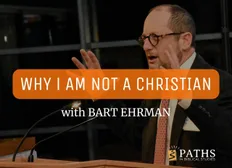 Online course
Why I Am Not a Christian
Online course
Why I Am Not a Christian
Related episodes
 Podcast
Why Study the Bible as an Atheist?
Podcast
Why Study the Bible as an Atheist?
 Podcast
8 Bible Myths Many Christians Believe
Podcast
8 Bible Myths Many Christians Believe
 Podcast
How Do We Separate History from Myth in the Gospels?
Podcast
How Do We Separate History from Myth in the Gospels?
Read next
 Article
10 Times Archaeology Has Disagreed with the Biblical Narrative
Article
10 Times Archaeology Has Disagreed with the Biblical Narrative
 Article
The Bronze Age Collapse: The Bible’s Invisible Catastrophe?
Featured Contribution from the Biblical Studies Academy Community
Find your path New to biblical scholarship?
Article
The Bronze Age Collapse: The Bible’s Invisible Catastrophe?
Featured Contribution from the Biblical Studies Academy Community
Find your path New to biblical scholarship? Two quick questions build you a personal route: free lectures, current articles and episodes, and the right course for your level.
Build my path →