A Lost Gospel

Gospel of Peter

Matthew, Mark, Luke, and John describe the empty tomb. The Gospel of Peter describes the moment Jesus walks out of it.

Gospel of Peter course art
Watch Anytime One 70-Minute Lecture Travis Proctor · Early Christianity

The Discovery

A lost gospel.
A walking cross.

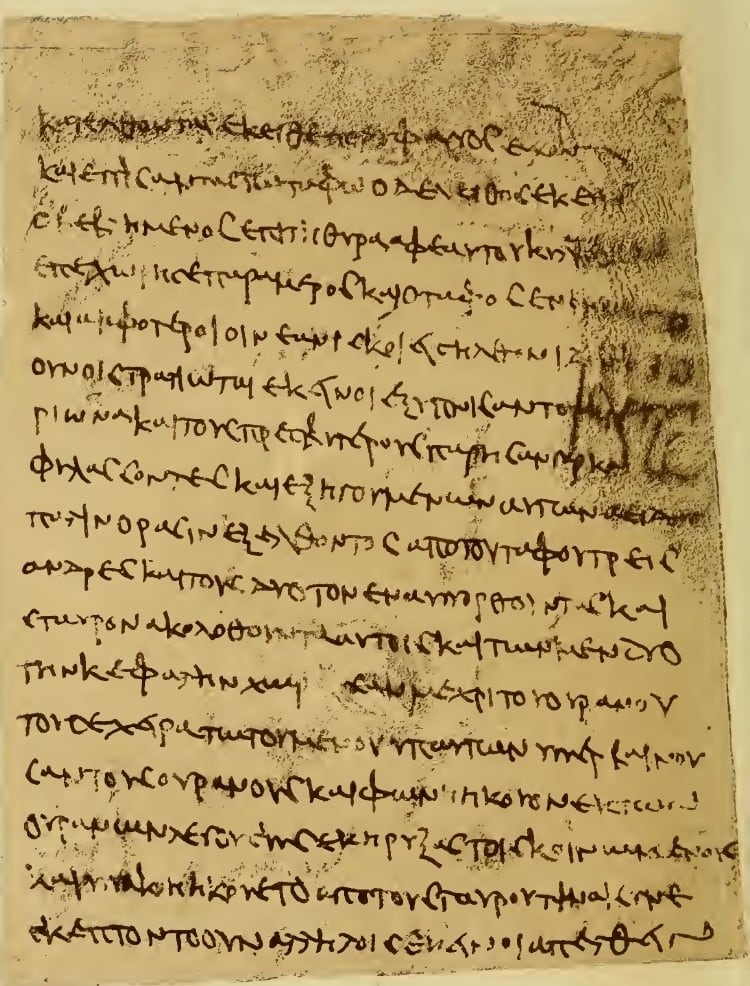
A page of the Greek Akhmim fragment of the Gospel of Peter
The Akhmim Fragment Panopolis, Upper Egypt · Found 1886

A text called the “Gospel of Peter” was known to have been used by some early Christians, though opposition from church leaders likely contributed to its exclusion from the emerging Christian canon. For most of history, this text was lost.

That was until the discovery of the Akhmim Codex, found buried in a tomb near the east bank of the Nile in Egypt. The gospel it contained narrates the trial, crucifixion, and resurrection of Jesus in ways similar to yet strikingly distinct from the canonical gospels, including a detailed description of the actual moment of Jesus’s resurrection, complete with a procession of angels, the risen Jesus, and a walking, talking cross.

The gospel also claims to have been written by Simon Peter himself, the most prominent of Jesus’s twelve disciples. Is this really the Gospel of Peter known to early Christians? Does it predate our other gospels? Could it shed new light on the historical Jesus?

At a Glance

Format

Recorded, on demand

One continuous lecture

70 minutes

Yours to download

Audio and slides

Access

Lifetime, watch anytime

Prerequisites

None. No Greek needed

Six questions,
one strange gospel.

Inside the Lecture

Seventy minutes, straight through. It is one continuous lecture rather than a series, organized around six questions that scholars have been arguing about since the fragment came out of the ground. Each one has a real answer, and none of them is the answer most people expect.

Question 01

Is this actually it?

The church fathers knew of a gospel circulating under Peter’s name. A codex dug out of an Egyptian grave contains a gospel written in Peter’s voice. Establishing that those are the same book turns out to be much harder than it sounds.

The identification
Question 02

Why was it left out?

Nothing about the canon was automatic. Somebody read this gospel, used it in worship, and was then told to stop. Who decided, on what grounds, and what that decision reveals about the boundaries being drawn.

The exclusion
Question 03

How old is it?

The manuscript we hold is centuries younger than the text it carries, and the text is older than the manuscript by an amount nobody agrees on. The dating question is where this gospel gets genuinely interesting.

The date
Question 04

Who copied whom?

It tells the same passion story as Matthew, Mark, Luke, and John, and it tells it differently. The obvious explanation is that it borrowed from them. A serious case has been made that the traffic ran the other way.

The relationship
Question 05

Does it reach the historical Jesus?

If any part of this gospel is early enough, it becomes evidence about what happened rather than evidence about what people later believed. That is a high bar, and the lecture weighs whether it clears it.

The history
Question 06

Is it docetic?

On the cross, this Jesus is silent, “as if he felt no pain.” That single clause is the reason a bishop banned the book, and the reason it still gets filed under heresy. Whether the charge holds is another question.

The heresy charge
TP
Travis Proctor Travis Proctor · 2026
Your Instructor

Travis Proctor.

Scholar of Early Christianity · Ph.D., UNC-Chapel Hill

A first-generation college graduate and scholar of the bible and early Christianity, Travis Proctor received his Ph.D. in Religious Studies from UNC-Chapel Hill, specializing in ancient Mediterranean religions. His teaching and research draw from interdisciplinary fields like religious studies, environmental history, animal studies, space and material culture, and ritual studies. His first book, Demonic Bodies and the Dark Ecologies of Early Christian Culture (Oxford University Press), explored how early Christian theorizations of demonic bodies influenced ancient understandings of cosmic “ecosystems,” and how such historical perspectives may inform contemporary environmental ethics.

His work has appeared in academic journals such as the Journal of the American Academy of Religion, Journal of Early Christian Studies, Harvard Theological Review, and the Journal of Ecclesiastical History, as well as public venues including Bible Odyssey, Religion for Breakfast, Religion Dispatches, The Bart Ehrman Blog, and the “Tell Me Something I Don’t Know” podcast. He lives in Ohio and enjoys hiking outdoors, a good round of disc golf, and watching Kansas City Chiefs football (even before Taylor Swift!)

Ph.D., UNC-Chapel HillDemonic Bodies (Oxford UP)Harvard Theological ReviewAncient Mediterranean Religions

70

Minutes · one continuous lecture

2

Downloads · audio and slides

Lifetime Access

Prepare to Rethink

Common assumptions
this lecture will challenge.

Common Assumption

A gospel left out of the New Testament must be a late forgery with nothing to tell us.

In fact

Being excluded and being late are two separate claims, and they need two separate arguments. Some early Christians read this book in church. Working out when it was written is a different job from working out why it was dropped.

Common Assumption

We found the Gospel of Peter in an Egyptian grave in 1886.

In fact

We found a gospel, in Greek, narrated in the first person by someone who calls himself Simon Peter. Whether it is the same book the early church argued over is one of the liveliest questions in the field, and the lecture takes it seriously.

Common Assumption

It is just the familiar passion story retold with the volume turned up.

In fact

It changes who orders the execution, what Jesus says from the cross, and who is standing there when the tomb opens. Those are not decorations. They are the kind of differences that make scholars ask which version came first.

Included with Enrollment

Included with
your lecture.

Audio Download

An MP3 of the full seventy minutes, for listening on a commute or a walk, whenever you are away from a screen.

The Presentation Slides

Dr. Proctor’s slides from the lecture, yours to download: the manuscript images, the passages, and the comparisons, in front of you at your own pace.

Lifetime Access

The lecture and the materials are yours to keep. Watch tonight, watch again next year, on any device, as often as you like.

$1 from every registration is donated to charity: water, bringing clean water to people in need.

2 ways to purchase this course

Stand-Alone Purchase

Enjoy the course at a fraction of the cost

Monthly Deal: 20% Off Through 9/30

Regular Price $24.95 Monthly Deal $19.96 Ends September 30

Use code sep20 at checkout


Included in Your Purchase: Lifetime access to this 70-minute recorded lecture, with:

  • Dr. Travis Proctor’s full 70-minute lecture
  • The presentation slides, yours to download
  • Audio download for listening on the go
  • Lifetime access, on demand
  • Biblical Studies Academy members save 30%

Access this Course PLUS Every Course in Our Vault

(250+ Hours of Biblical Learning!)

  • 50+ existing courses plus all new releases (we're aiming for 20+ new courses in 2026)
  • All "Face to Face on the Bible" events and debates
  • Bart Ehrman's monthly "Spotlight" lectures
  • Join 1,700+ members for discussion, member mixers, trivia, book club, & more!
Start FREE Trial

then special rate $49.95/month

Frequently Asked

Everything you
need to know.

How long is it, and what exactly do I get?

Seventy minutes: Dr. Proctor’s full recorded lecture on the Gospel of Peter, in one continuous session. With it you get his presentation slides and an audio download of the whole thing, all yours with lifetime access.

Is this a full course or a single lecture?

A single, self-contained lecture of about seventy minutes. It is complete on its own: you do not need to have taken anything else first, and nothing else is required to follow it.

Is there a Q&A session included?

Not on this one. This is the lecture on its own, seventy uninterrupted minutes. Many of our other recorded sessions do include a moderated Q&A; this one does not, and the price reflects that.

When can I watch it?

Immediately. Everything is already recorded, so the lecture is available as soon as you enroll. There are no live sessions and no schedule to keep.

How will I access it?

After you enroll you will receive login instructions for our online course platform, ThriveCart Learn, where the video, the slides, and the audio download are all posted. If you are a member of Biblical Studies Academy (BSA), your access will also be available inside the community.

Do I have lifetime access?

Yes. The lecture, the slides, and the audio download are yours with lifetime access. Watch and re-watch on any device, on your own schedule, as often as you like.

Do I need any background in the Bible, or any Greek?

No. Every passage is discussed in English, and every text and figure is introduced as it comes up. No prior study is needed.

What is the Gospel of Peter?

An early Christian account of the trial, crucifixion, and resurrection of Jesus, written in the first person by an author who identifies himself as Simon Peter. It was known to some early Christian writers and then lost, until a Greek copy was found in a grave at Akhmim in Upper Egypt in 1886. It is not part of the New Testament.

Is the Akhmim text really the Gospel of Peter?

That is one of the six questions the lecture takes on, and it is a genuinely open one. The church fathers knew of a gospel circulating under Peter’s name; the Akhmim codex holds a gospel narrated by someone calling himself Peter. Showing that those are the same book is harder than it looks, and Dr. Proctor walks through what the evidence can and cannot establish.

What is “docetism,” and why does it come up?

Docetism is the early Christian view that Christ only appeared to have a physical body, and so only appeared to suffer. The Gospel of Peter has long attracted the label, largely because of one clause at the crucifixion. Whether the charge actually fits the text is one of the questions the lecture examines.

Are any other discounts available?

Yes. Viewers of Dr. Ehrman’s Misquoting Jesus show on YouTube, and listeners of the podcast, can find exclusive discount codes there. Members of Biblical Studies Academy (BSA) receive 30% off with their member coupon code.

Can I get this as part of a membership instead?

Yes. Biblical Studies Academy (BSA) includes this lecture along with our entire catalog, and it starts with a 14-day free trial.

What payment types are accepted?

We accept PayPal and all major credit cards.

Do you offer a money-back guarantee?

Absolutely. If you don’t love it, send us an email at support@bartehrman.com within 30 days of purchase and we will refund every penny.