 All episodes →
 Misquoting Jesus Podcast
Can Christians Study the New Testament Honestly?
Show notes
Episode Outline:
Can committed Christians study the Bible historically and critically?
Bart and Megan on teaching, undergrads, and new Akkadian classes
How Bart’s own faith once shaped his biblical scholarship
From fundamentalism to a more critical historical approach
How Bart’s conclusions changed once he began reading historically
Can non-Christians really understand the New Testament?
What about the claim that you need the Holy Spirit to interpret Scripture?
How Christian scholars can study a sacred text responsibly
How Bart handled the tension between faith and historical truth
When religious conviction starts to distort scholarship
Why some traditions make critical scholarship harder than others
Cognitive dissonance, apologetics, and protecting prior beliefs
Does historical study necessarily weaken Christian faith?
Can inerrantists still do rigorous academic scholarship?
What kinds of methods become difficult if every Gospel word must be historical
Weekly Update: final push for the New Insights conference
Listener Q&A: prayer in scholarship, software for manuscripts, and learning Koine Greek
Final summary: bias, faith, and historical method in New Testament studies
Episode Description
Many Christians think that a non-Christian simply can't understand the New Testament fully, since they don't agree with its major teachings. But could an argument be made for the opposite case, that those with a vested interest in the New Testament as a book inspired by God cannot get beyond their theological assumptions to understand what the text is really saying? It seems like an odd question, but can committed Christians really study their own Scriptures honestly? In this episode we consider the issue from several angles, not by assuming that outsiders are necessarily "objective" (is anyone objective?) but by thinking through the complications of the matter.
Also watch these episodes:
New Testament Scholarship for Non-Scholars
New Testament Scholarship for Non-Scholars
Does Biblical Scholarship Destroy Faith?
Does Biblical Scholarship Destroy Faith?
The Scholar and the Savior: Bridging Belief and Critical Study
The Scholar and the Savior: Bridging Belief and Critical Study
Megan asks Bart:
-I’ve heard it argued that people who are not Christians can’t actually understand Christianity, and by extension the New Testament. As an agnostic expert on the NT and early Christianity, what is your opinion?
-What do you think about people who insist that you can’t understand the NT without the guidance of the holy spirit?
-How can or should Christian academics go about understanding a text that they hold to be divine in an historical manner?
-How did you deal with that as you moved away from the faith?
-What factors do you think make it more likely for religious convictions to adversely impact academic research?
-Are there some religious backgrounds, or educational trajectories, that make this easier for academics to do?
-Does maintaining a Christian faith while studying the Bible in an academically rigorous and responsible manner require a level of comfort with cognitive dissonance, or is it really not that difficult?
-Does treating the Bible as an historical text say anything about one’s religious conviction?
-Do you think it’s possible to hold to that commitment of divine inspiration and inerrancy and still conduct rigorous academic research?
-What makes it hard for evangelical academics to do the kind of work that you’ve gone on to do?
-What kinds of methodologies require you to have that suspension of faith?
Can committed Christians study the Bible historically and critically?
Bart and Megan on teaching, undergrads, and new Akkadian classes
How Bart’s own faith once shaped his biblical scholarship
From fundamentalism to a more critical historical approach
How Bart’s conclusions changed once he began reading historically
Can non-Christians really understand the New Testament?
What about the claim that you need the Holy Spirit to interpret Scripture?
How Christian scholars can study a sacred text responsibly
How Bart handled the tension between faith and historical truth
When religious conviction starts to distort scholarship
Why some traditions make critical scholarship harder than others
Cognitive dissonance, apologetics, and protecting prior beliefs
Does historical study necessarily weaken Christian faith?
Can inerrantists still do rigorous academic scholarship?
What kinds of methods become difficult if every Gospel word must be historical
Weekly Update: final push for the New Insights conference
Listener Q&A: prayer in scholarship, software for manuscripts, and learning Koine Greek
Final summary: bias, faith, and historical method in New Testament studies
Episode Description
Many Christians think that a non-Christian simply can't understand the New Testament fully, since they don't agree with its major teachings. But could an argument be made for the opposite case, that those with a vested interest in the New Testament as a book inspired by God cannot get beyond their theological assumptions to understand what the text is really saying? It seems like an odd question, but can committed Christians really study their own Scriptures honestly? In this episode we consider the issue from several angles, not by assuming that outsiders are necessarily "objective" (is anyone objective?) but by thinking through the complications of the matter.
Also watch these episodes:
New Testament Scholarship for Non-Scholars
New Testament Scholarship for Non-Scholars
Does Biblical Scholarship Destroy Faith?
Does Biblical Scholarship Destroy Faith?
The Scholar and the Savior: Bridging Belief and Critical Study
The Scholar and the Savior: Bridging Belief and Critical Study
Megan asks Bart:
-I’ve heard it argued that people who are not Christians can’t actually understand Christianity, and by extension the New Testament. As an agnostic expert on the NT and early Christianity, what is your opinion?
-What do you think about people who insist that you can’t understand the NT without the guidance of the holy spirit?
-How can or should Christian academics go about understanding a text that they hold to be divine in an historical manner?
-How did you deal with that as you moved away from the faith?
-What factors do you think make it more likely for religious convictions to adversely impact academic research?
-Are there some religious backgrounds, or educational trajectories, that make this easier for academics to do?
-Does maintaining a Christian faith while studying the Bible in an academically rigorous and responsible manner require a level of comfort with cognitive dissonance, or is it really not that difficult?
-Does treating the Bible as an historical text say anything about one’s religious conviction?
-Do you think it’s possible to hold to that commitment of divine inspiration and inerrancy and still conduct rigorous academic research?
-What makes it hard for evangelical academics to do the kind of work that you’ve gone on to do?
-What kinds of methodologies require you to have that suspension of faith?
Go deeper on this topic
 Online course
Scribal Corruption of Scripture: How the Bible Was Changed and Why Readers May Never Know
Based on a New York Times bestselling book, this course explores questions critically important to anyone interested in the New Testament: Do we have the original…
Online course
Scribal Corruption of Scripture: How the Bible Was Changed and Why Readers May Never Know
Based on a New York Times bestselling book, this course explores questions critically important to anyone interested in the New Testament: Do we have the original…
 Free courseFree
Why I Am Not a Christian
Bart’s own story, from fundamentalist to agnostic scholar. Four free lectures.
Free courseFree
Why I Am Not a Christian
Bart’s own story, from fundamentalist to agnostic scholar. Four free lectures.
Related episodes
 Podcast
Does Biblical Scholarship Destroy Faith?
Podcast
Does Biblical Scholarship Destroy Faith?
 Podcast
New Testament Scholarship for Non-Scholars
Podcast
New Testament Scholarship for Non-Scholars
 Podcast
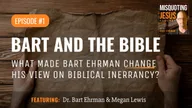
Bart and the Bible: What Made Bart Ehrman Change His View on Biblical Inerrancy?
Podcast
Bart and the Bible: What Made Bart Ehrman Change His View on Biblical Inerrancy?
Read next
 Article
What is the Best Study Bible? (Ratings, Features, & Bart’s Favorite)
Article
What is the Best Study Bible? (Ratings, Features, & Bart’s Favorite)
 Article
How to Study the Bible (The Answer May Surprise You!)
Find your path New to faith, doubt & deconstruction?
Article
How to Study the Bible (The Answer May Surprise You!)
Find your path New to faith, doubt & deconstruction? Two quick questions build you a personal route: free lectures, current articles and episodes, and the right course for your level.
Build my path →