 All episodes →
 Misquoting Jesus Podcast
Why Study the Bible as an Atheist?
Show notes
Episode Outline:
— Why would an atheist study the Bible?
— How faith shaped Bart’s path into biblical studies
— When Bart first encountered atheist Bible scholars
— Bart’s move away from fundamentalism and Christianity
— How deconversion changed Bart’s view of the Bible
— Why Bart stayed in biblical studies after leaving Christianity
— Why biblical studies still matters outside of faith
— Why non-Christians can study Christianity academically
— Scholar Spotlight: David Parker and The Living Text of the Gospels
Episode Description
Episode 153 begins with Megan Lewis raising the intriguing issue of why anyone would devote their academic career to the scriptures of a faith they don't personally practice. Bart Ehrman candidly shares his own path: raised with a general knowledge of the Bible, it was only after a transformative “born again” experience that he felt called to study scripture deeply. Ehrman’s spiritual journey led him to fundamentalism, where the Bible was seen as the literal, inerrant word of God. This intense faith inspired him to apply himself rigorously as a scholar—he even credits his passion for the Bible as the reason he became an academic in the first place.
However, as Ehrman’s training progressed through institutions like Moody Bible Institute, he encountered challenging questions and textual contradictions that led to a long, gradual process of deconversion. Crucially, he emphasizes that his atheism ultimately resulted not from discovering errors or inconsistencies in the Bible, but from grappling with the philosophical problem of suffering in the world.
Throughout the discussion, Bart and Megan explore why biblical studies shouldn’t be—or can’t be—reserved solely for believers, drawing parallels to the study of other ancient texts. Why is it considered natural to study Mesopotamian religion (without being a Mesopotamian), but controversial to teach New Testament studies as a non-Christian? Ehrman argues for the cultural, historical, and intellectual importance of critical scholarship and highlights how the Bible has shaped Western civilization, art, literature, philosophy, and even political discourse.
The hosts discuss how foundational assumptions—such as viewing the Bible as a single, unified work—can hinder genuine understanding. Ehrman shares how his move away from fundamentalist theology released him from the compulsion to harmonize contradictions, opening new avenues for scholarly exploration and deeper insight.
Further, they touch on public controversies: how biblical texts are often wielded in modern social and political debates, sometimes misquoted or misunderstood, emphasizing the value of accurate knowledge regardless of personal faith.
Later in the episode, Bart shines a "Scholar Spotlight" on David Parker (author of "The Living Text of the Gospels") and provides resources for listeners who wish to take their studies further.
Three Key Takeaways
1. You Don’t Have to Believe to Study: Critical, open-minded study of religious texts isn’t reserved for believers—atheists and non-Christians can bring essential perspectives, just like in any other field of historical or literary study.
2. Personal Revelation Shapes Scholarship: Ehrman’s dedication to biblical studies was initially driven entirely by personal faith. But as his beliefs evolved, so did his approach—highlighting that scholarship and personal belief are related but not always synonymous.
3. Understanding vs. Advocacy: Deep knowledge of the Bible is crucial—not just for personal faith, but for cultural literacy, and to guard against the misuse or misunderstanding of scripture in society.
Also watch these episodes:
Does Biblical Scholarship Destroy Faith?
Does Biblical Scholarship Destroy Faith?
Can Christians Study the New Testament Honestly?
Can Christians Study the New Testament Honestly?
The Bible Says So: What We Get Right and Wrong About the Bible
The Bible Says So: What We Get Right and Wrong About the Bible
— Why would an atheist study the Bible?
— How faith shaped Bart’s path into biblical studies
— When Bart first encountered atheist Bible scholars
— Bart’s move away from fundamentalism and Christianity
— How deconversion changed Bart’s view of the Bible
— Why Bart stayed in biblical studies after leaving Christianity
— Why biblical studies still matters outside of faith
— Why non-Christians can study Christianity academically
— Scholar Spotlight: David Parker and The Living Text of the Gospels
Episode Description
Episode 153 begins with Megan Lewis raising the intriguing issue of why anyone would devote their academic career to the scriptures of a faith they don't personally practice. Bart Ehrman candidly shares his own path: raised with a general knowledge of the Bible, it was only after a transformative “born again” experience that he felt called to study scripture deeply. Ehrman’s spiritual journey led him to fundamentalism, where the Bible was seen as the literal, inerrant word of God. This intense faith inspired him to apply himself rigorously as a scholar—he even credits his passion for the Bible as the reason he became an academic in the first place.
However, as Ehrman’s training progressed through institutions like Moody Bible Institute, he encountered challenging questions and textual contradictions that led to a long, gradual process of deconversion. Crucially, he emphasizes that his atheism ultimately resulted not from discovering errors or inconsistencies in the Bible, but from grappling with the philosophical problem of suffering in the world.
Throughout the discussion, Bart and Megan explore why biblical studies shouldn’t be—or can’t be—reserved solely for believers, drawing parallels to the study of other ancient texts. Why is it considered natural to study Mesopotamian religion (without being a Mesopotamian), but controversial to teach New Testament studies as a non-Christian? Ehrman argues for the cultural, historical, and intellectual importance of critical scholarship and highlights how the Bible has shaped Western civilization, art, literature, philosophy, and even political discourse.
The hosts discuss how foundational assumptions—such as viewing the Bible as a single, unified work—can hinder genuine understanding. Ehrman shares how his move away from fundamentalist theology released him from the compulsion to harmonize contradictions, opening new avenues for scholarly exploration and deeper insight.
Further, they touch on public controversies: how biblical texts are often wielded in modern social and political debates, sometimes misquoted or misunderstood, emphasizing the value of accurate knowledge regardless of personal faith.
Later in the episode, Bart shines a "Scholar Spotlight" on David Parker (author of "The Living Text of the Gospels") and provides resources for listeners who wish to take their studies further.
Three Key Takeaways
1. You Don’t Have to Believe to Study: Critical, open-minded study of religious texts isn’t reserved for believers—atheists and non-Christians can bring essential perspectives, just like in any other field of historical or literary study.
2. Personal Revelation Shapes Scholarship: Ehrman’s dedication to biblical studies was initially driven entirely by personal faith. But as his beliefs evolved, so did his approach—highlighting that scholarship and personal belief are related but not always synonymous.
3. Understanding vs. Advocacy: Deep knowledge of the Bible is crucial—not just for personal faith, but for cultural literacy, and to guard against the misuse or misunderstanding of scripture in society.
Also watch these episodes:
Does Biblical Scholarship Destroy Faith?
Does Biblical Scholarship Destroy Faith?
Can Christians Study the New Testament Honestly?
Can Christians Study the New Testament Honestly?
The Bible Says So: What We Get Right and Wrong About the Bible
The Bible Says So: What We Get Right and Wrong About the Bible
Go deeper on this topic
 Online course
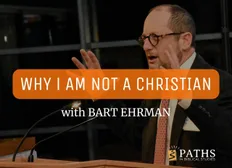
Why I Am Not a Christian
Free courseFree
Why I Am Not a Christian
Bart’s own story, from fundamentalist to agnostic scholar. Four free lectures.
Online course
Why I Am Not a Christian
Free courseFree
Why I Am Not a Christian
Bart’s own story, from fundamentalist to agnostic scholar. Four free lectures.
Related episodes
 Podcast
The One Verse That Made Bart Question Everything
Podcast
The One Verse That Made Bart Question Everything
 Podcast
Does Biblical Scholarship Destroy Faith?
Podcast
Does Biblical Scholarship Destroy Faith?
 Podcast
Three "Myths" Atheists Believe
Podcast
Three "Myths" Atheists Believe
Read next
 Article
How to Study the Bible (The Answer May Surprise You!)
Article
How to Study the Bible (The Answer May Surprise You!)
 Article
What is the Best Study Bible? (Ratings, Features, & Bart’s Favorite)
Find your path New to faith, doubt & deconstruction?
Article
What is the Best Study Bible? (Ratings, Features, & Bart’s Favorite)
Find your path New to faith, doubt & deconstruction? Two quick questions build you a personal route: free lectures, current articles and episodes, and the right course for your level.
Build my path →