
Theme I
Wealth in Jesus’ World
The gap between the first-century economy and ours is almost impossible to grasp. Grasping it changes everything about how you read Jesus on money.
What Jesus really taught about wealth, and whether he meant it.
A Saying Everyone Quotes, Few Understand

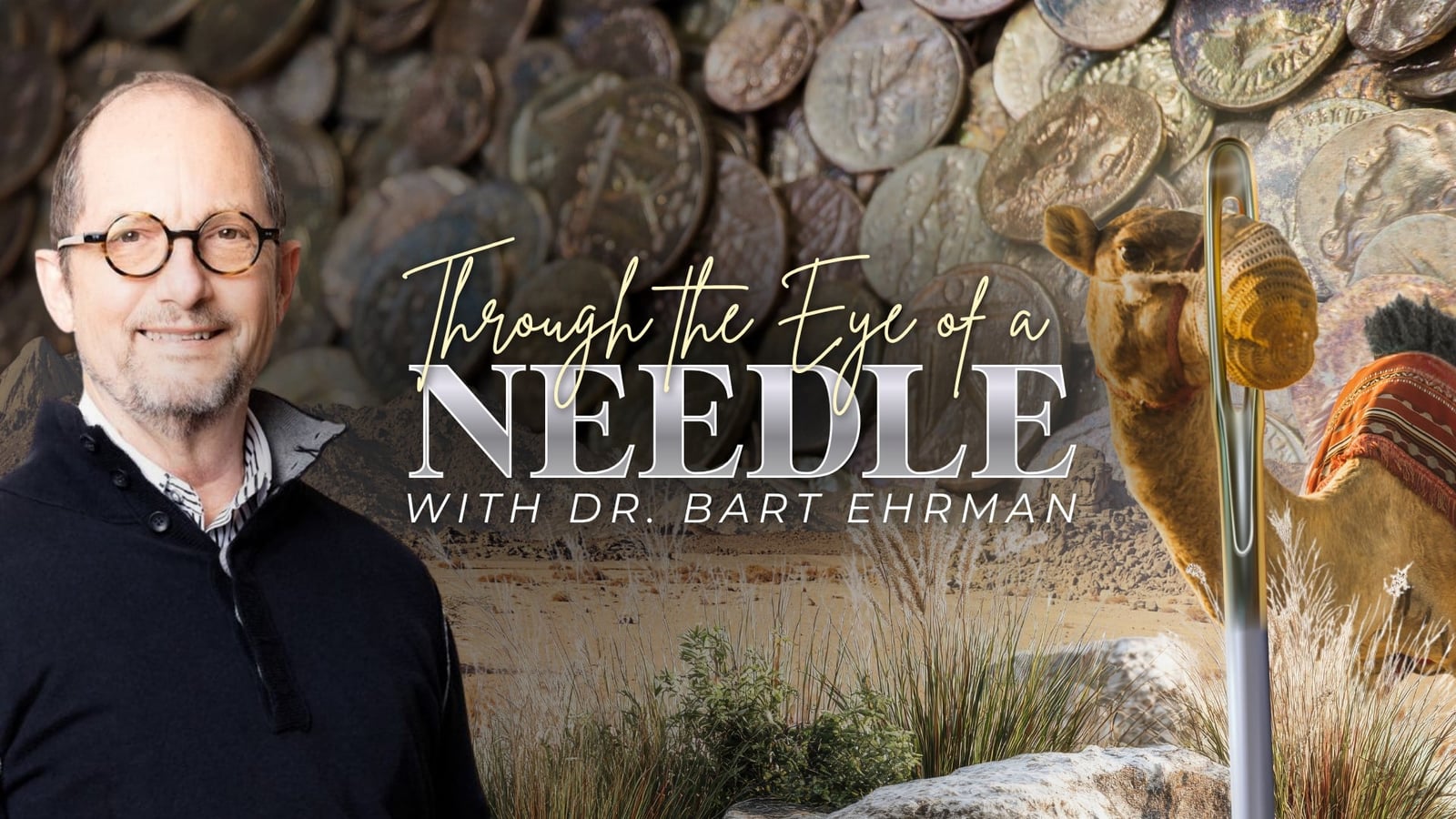
“It is easier for a camel to go through the eye of a needle than for a rich man to enter the kingdom of God.” It is one of the most quoted lines in the Gospels, and one of the least understood. Did Jesus mean it literally? Did he mean it at all?
The economic world Jesus lived in is almost impossible for us to picture. A handful of the very rich, a thin layer of those who scraped by, and beneath them the vast majority: the poor, and below even them, the destitute. Jesus preached into that world, in small Galilean villages, convinced that God was about to bring all of it to an end.
Strip away two thousand years of assumption and the question gets sharper, not simpler. Was Jesus against wealth, or against something subtler? A proto-capitalist, a proto-socialist, or neither? Why does he keep promising rewards for generosity, and is that even altruism? This course goes back to the texts themselves to find what Jesus actually said about money, and why it still will not leave us alone.
Format
On-demand video
Lectures
8 · plus 2 live Q&A
Access
Lifetime, watch anytime
Instructor
Bart Ehrman
Specialty
New Testament & the Historical Jesus
Six Core Themes
From the economics of a Galilean village to the monastic invention of the hospital, these are the threads the course pulls on.
The gap between the first-century economy and ours is almost impossible to grasp. Grasping it changes everything about how you read Jesus on money.
Surely Jesus could not have meant it: a camel, through the eye of a needle. We look at what the words actually said, and to whom they were said.
Many American Christians argue that Jesus blessed the accumulation of wealth. We examine the parables they cite, and what those parables actually say.
Others are just as certain he was a socialist. That reading has real problems too, and the problems reveal the limits of pinning any modern label on Jesus.
Jesus almost always sweetens doing good for others with a promise of reward for yourself. Is that altruism, or something more complicated?
Hospitals, orphanages, food banks for the poor: nearly all of it traces back to the Christian monastic movement. Almost no one knows the story.
 Bart D. Ehrman · 2026
 James A. Gray Distinguished Professor of Religious Studies Emeritus · University of North Carolina at Chapel Hill
Bart D. Ehrman is the James A. Gray Distinguished Professor Emeritus of Religious Studies at the University of North Carolina at Chapel Hill, where he taught from 1988 until his retirement in 2025. Recognized internationally for his scholarship on the New Testament and early Christianity, Professor Ehrman has written or edited thirty-three books, including six New York Times bestsellers. His college-level textbook The New Testament: A Historical Introduction to the Early Christian Writings has remained the best-selling text in the field for more than twenty-five years. His scholarly works have been published by Oxford, Harvard, Yale, and other premier academic presses, and his books have been translated into twenty-seven languages, reaching millions of readers worldwide.
Beyond the classroom, Professor Ehrman is a widely recognized public scholar. He has produced nine acclaimed courses for The Great Courses, in addition to numerous online courses available through BartEhrman.com. His books and courses have sold more than two million copies.
He also writes for his charitable blog, The Bart Ehrman Blog, which has raised millions for organizations addressing poverty, homelessness, and hunger. In addition, he hosts the weekly podcast Misquoting Jesus with Bart Ehrman, available on YouTube and all major podcast platforms, where he brings cutting-edge biblical scholarship to a global audience.
What This Course Offers
Bart Ehrman reads the sayings on wealth back into the world that produced them, with the historian’s tools, for anyone who has ever wondered what Jesus really asked of the rich.
Every claim is traced to the actual words attributed to Jesus. No theology, no preaching, just the texts, read carefully.
Rigorous historical-critical analysis, separating what Jesus likely said from what later tradition added. This is how historians actually work.
The capitalist and socialist readings, strongest arguments and real weaknesses, side by side.
All eight lectures and both live Q&A sessions on demand, the moment you enroll. Lifetime access to revisit and rewatch.
It does not stop at history. It asks what, if anything, a first-century ethic means for the economy we actually live in.
Built for curious, thoughtful people, not seminarians. If you read the news and care about ideas, this course is for you.
Common Assumption
Jesus was clearly against wealth.
In fact
Read the sayings in their real economic and apocalyptic setting and a stranger, more specific picture emerges, one that fits neither the anti-wealth sermon nor its comfortable opposite.
Common Assumption
The rich man passage was just for one person.
In fact
The famous bar set for the rich young ruler looks, on a close reading of what surrounds it, far less like a special exception and far more like something meant for everyone.
Common Assumption
WWJD gives clear economic guidance.
In fact
Capitalism, socialism, markets, governments: none of it would have meant anything to Jesus. Asking what he would do in our economy may be the wrong question, and seeing why changes how you read every saying.
Common Assumption
Charitable institutions are just common sense.
In fact
Hospitals, orphanages, organized relief for the hungry: we assume they always existed. Where they actually came from, and what it has to do with Jesus on wealth, surprises almost everyone.
All eight lectures and both live Q&A sessions are available to watch the moment you enroll. Click any lecture to read its description.
Economics in the Days of Jesus. The economic shape of the first-century Roman world: the distribution of rich, poor, and destitute, the chances of employment, the weight of taxation. Then a narrowing of focus to the villages of rural Galilee, and how those circumstances explain Jesus’ teachings on money.
Is Wealth a Problem? The Greek and Roman Worlds. How pagan moral teachers treated wealth as a possible problem: for whom, and why. How they thought money should be given away, to whom and on what terms, and how unlike modern charity those assumptions were.
Problems with Wealth in the Ancient Jewish World. From pagan philosophy to ancient Judaism, beginning with the Hebrew Bible’s insistence that those with resources must provide for the poor, the rise of almsgiving, and the striking idea that giving could atone for sin.
Jesus and Wealth. Jesus’ own understanding of wealth and its obligations, overlapping with other Jewish teachers but diverging sharply, driven by his conviction that the Day of Judgment was near: a radical, universal ethic of giving with no time for half-measures.
Was Jesus a Capitalist? The case that Jesus saw wealth accumulation as good and godly, built on the Parables of the Workers in the Vineyard, the Talents, the Sower, and the Mustard Seed. We test each reading to see whether it holds up.
Was Jesus a Socialist? The opposite case, built on Jesus’ opposition to unequal wealth and his call for the well-off to give to the poor. We ask honestly whether it makes sense to read modern economic systems back into his words.
Difficult Passages and the Troubling Views of Jesus. The hard sayings: praise for a dishonest steward, the call to abandon job and family, the advice not to worry about food or clothing. We confront them directly and trace how they have been read over the centuries.
The Real-World Effects of Jesus’ Teachings on Wealth. From the first believers who sold everything, to the fourth and fifth-century monks who built hospitals and orphanages, set against the rival impulse to accumulate, and how both streams still echo in Christian economic debate.
Full recordings of both 45-minute live Q&A sessions, so you can revisit the questions and Bart’s answers anytime.
Download Bart’s full slide decks for all eight lectures, ideal for review, note-taking, or sharing with a study group.
Searchable transcripts of every lecture, perfect for quoting, deeper study, or following along if English is not your first language.
MP3 downloads of every lecture. Listen on your commute, during a walk, or whenever you’re away from a screen.
An exclusive bonus lecture, “Laborers and Management in the Vineyard: How to Assess Kingdom Economics,” presented by Dr. Amy-Jill Levine.
Curated discussion questions and a recommended reading list for each lecture, for going deeper on your own or with a study group.
A quiz to test your understanding and reinforce the key ideas across all eight lectures.
$1 from every registration is donated to charity: water, bringing clean water to people in need.
Enjoy the course at a fraction of the cost
$199.80 Value Each single-lecture course retails for $24.95; eight of them, plus the two live Q&A sessions, is the $199.80 value.
$79.95
Included in Your Purchase: Lifetime Access to This University-Level Course With:

Access this Course PLUS Every Course in Our Vault
(250+ Hours of Biblical Learning!)
then special rate $49.95/month
Bart Ehrman presents eight lectures, each running about 50 minutes, plus full recordings of both 45-minute live Q&A sessions from the original event. All are available on demand, so you can watch at your own pace.
It began as a live two-day event (May 16 and 17, 2026). It is now available in full as an on-demand recording, including both live Q&A sessions, so you can watch whenever works for you.
Yes. As soon as you purchase the course, you receive an email with login instructions for our online platform, ThriveCart Learn. You can immediately access all eight lectures, both Q&A recordings, and every bonus.
You will have lifetime access to the course materials. Watch the lectures, download the transcripts, and review the slides as many times as you like, whenever works best for your schedule.
No prior knowledge is required. Bart introduces all the relevant texts, historical background, and scholarly context as the course unfolds. Whether you’re coming in fresh or already have a background in biblical studies, you’ll find it genuinely rewarding.
Yes. All lecture recordings include closed captions, and full transcripts are included with the course, so you can follow along in text or search for specific passages.
We accept PayPal and all major credit cards.
Absolutely. If you don’t love the course, send us an email at support@bartehrman.com within 30 days of purchase and we will refund every penny.
Comparable weekend intensives and academic workshops with scholars of this caliber regularly run hundreds of dollars per attendee. This course delivers eight full lectures, two live Q&A sessions, and a complete set of study materials online, at a price meant to keep serious biblical scholarship genuinely accessible.